
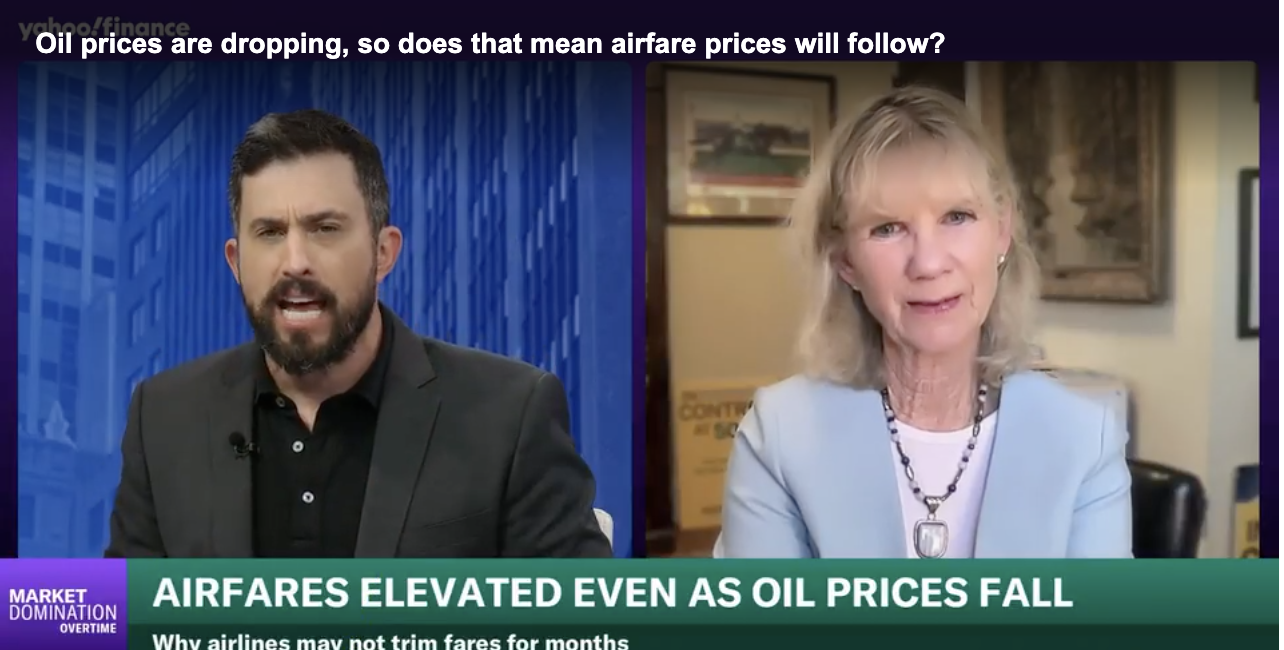
Now fuel costs are drifting downward, but that doesn’t mean airfares will follow in any meaningful way soon.
“Do not watch for a plunge in airfares like what’s happening in gasoline prices,” Michael Boyd, an aviation industry consultant, told Yahoo Finance.
While average airfares have declined modestly in recent weeks, according to tracking firms, they’re more than 20% higher than a year ago.
Both domestic and international fares peaked in May, but flights within the US are roughly 24% more expensive than a year ago, while international flights are up 16%, according to Kayak.
But that isn’t stopping people from hitting the skies. Seven in 10 Americans said they already are or are planning to travel this summer despite the price hikes, with only 13% indicating they’ve canceled travel, according to new Experian data.
“Jet fuel is dropping, but the indications are that the market can bear higher costs of air travel,” Boyd said. “That will be the driving pricing consideration in the future.”
Prices for jet fuel remain high
On Tuesday, the average price of a gallon of jet fuel was $2.86, according to the tracking firm Argus. That’s a drop of more than $2 per gallon from the peak in April, though still higher than before the war in Iran started in February.
“Oil supply through the Strait of Hormuz remains uncertain, and it is likely to take time before the benefit of lower oil prices is reflected in ‘normalized’ jet fuel pricing,” according to Willie Walsh, head of the International Air Transport Association, which represents airlines around the world, in a new report. “In the meantime, airlines who are operating on a 2.0% margin will have little choice but to continue testing demand resilience with higher fares that attempt to cover elevated fuel costs.”
Even if fuel continues to dip lower, airlines may not trim fares for months.
“The airlines lost a lot of money in the second quarter because they’d already booked a large portion of the quarter and then suddenly fuel spiked,” Atul Maheswari, an analyst at UBS Group in the transportation sector, told Yahoo Finance. “So they’re going to try to recover some of that before really passing along the benefit of the moderation in fuel prices.”
Demand to take off is unabated
With the flying public taking sticky prices in stride, the airlines are taking note.
“While demand remains strong in the US domestic market, then air fares will remain at their current levels,” said John Grant, analyst at aviation data provider OAG.
Historically, when fuel declines, fares fall with it, according to a new Melius Research brief published Wednesday.
“The industry has rarely proven it can hold pricing once the cost pressure justifying it fades,” per the analysis. “This time may be different.”
The real test will be after Labor Day, when summer travel demand ends “and airlines adjust fall capacity for a lower-fuel environment,” the report said. “If demand moderates even at the margin, or if supply is added back too quickly, the old addiction to fare sales and discounting could return.”
Glimmers of good news
If you’re eying a late summer or fall trip, prices are easing right now. International airfares are at a 13-week low, and domestic airfare is at a five-week low, per Kayak.
“We’re already starting to see fares dropping from the sticker shock-inducing peak we saw in May,” said Sean Cudahy, senior aviation reporter at The Points Guy. “Prices are still higher than they were last year, but they’re cheaper than they were a few weeks ago.”
In fact, August domestic fares have dropped enough that you might want to consider squeezing in a late-summer getaway, he said. “Ultimately, however, airlines will likely only feel inclined to drop big flight discounts if they suddenly run into trouble filling seats.”
There’s no crystal ball that tells us when prices will drop, but travelers can shop knowing when prices are historically up or down, said Melanie Fish, Expedia Group’s travel expert. December is the most expensive month to fly, and August is the least expensive month, saving travelers around $120 per ticket on average, she said.
When you book really matters. “Your booking day and your travel day can be the difference between overpaying and unlocking meaningful savings,” she said,
Generally, for domestic flights, Tuesday is the best day to unlock savings compared to Sunday, the most expensive day. Flying on a Friday can also save you money. “The real trick is setting up flight price alerts or taking advantage of price drop protection so you can book whenever and know you’ll get money back if the price drops,” Fish said.
Read the latest financial and business news from Yahoo Finance
