
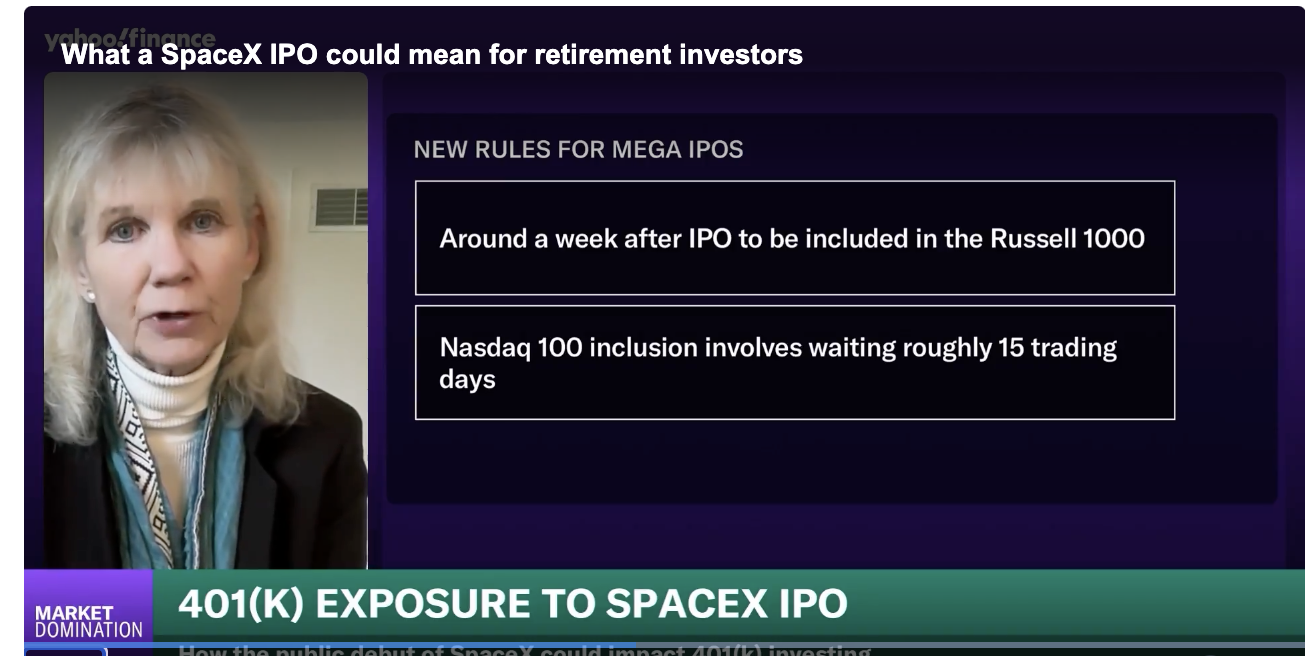
The rules are being rewritten for SpaceX to make it easier for small investors to get in on the launch.
For starters, rules to protect passive investors — including workers saving for retirement — that keep unproven firms out of index funds have been eased, meaning SpaceX will begin trading on two major indexes within a few days of its IPO. If you’re investing in a 401(k) via broad index funds, a sliver of the rocket and satellite company is likely to wind up in your account.
And this week, Fidelity reduced the minimum account balance requirement for its customers to invest in SpaceX to just $2,000. The previous balance required was $100,000 or $500,000, depending on the IPO.
Fidelity said it reduced IPO eligibility because SpaceX is allocating a higher-than-usual share of the offering to retail investors.
“Most initial public offerings (IPOs) offer retail customers only 5% to 10% of the total offering, which significantly reduces the amount of
stock available to our retail clients,” Fidelity posted in a Q&A on its website. “SpaceX has decided to reserve a much higher percentage of the offering (up to 30%), which means there should be more shares available to retail clients, which is why we have decided to reduce IPO eligibility for this offering.”
So there’s ample opportunity to get in on this history-making IPO. But is it wise?
“Investors should be careful not to confuse access with opportunity,” financial planner Lazetta Rainey Braxton said. “A great company can still be a poor investment if the price paid assumes too much future success.”
Seeing through the hype
Retirement savers and inexperienced investors may feel the excitement around a company pushing new boundaries of space exploration, Braxton noted, while knowing little about IPOs.
“The allure of investments typically associated with institutional and ultra-wealthy investors can be seductive,” she told Yahoo Finance. “Many retail investors see an opportunity like SpaceX and focus on finally getting a chance to own something that is typically out of reach.”
“What concerns me is that many retail investors appear to be evaluating SpaceX as a cultural phenomenon rather than a financial asset,” added Mark Stancato, a financial adviser at VIP Wealth Advisors in Decatur, Ga.
“They’re buying the rockets, the innovation, the Elon Musk story, and the dream of Mars,” he said. “Those may all be compelling narratives, but narratives can also lead investors to stop asking hard questions about valuation and expected returns.”
As with any investment, you need to know what you’re buying.
While SpaceX targets a record-setting valuation of almost $1.8 trillion and an IPO offering price of $135 per share, its financials are under close scrutiny. Morningstar this week estimated its valuation at far less — $780 billion — as its analysts said the company is overvalued in almost any scenario, at least in the near term.”
The analysis cited uncertainty about risk, regulations, and even the dependency on Musk as SpaceX’s key person. The balance sheet is sound, Morningstar said, despite aggressive spending on AI build-out and a heavy debt burden.
SpaceX, Stancato said, has “billions in operating losses, massive capital commitments to Starship and AI infrastructure, significant debt, and a founder who will retain effective control after the IPO.”
Fidelity will require retail investors to refrain from selling any SpaceX stock within the first 15 calendar days of trading. Otherwise, they will mark you as a “flipper,” charge a penalty, and block access to future IPOs.
“So you’re committed in a way a lot of first timers won’t read the fine print on,” he said. “For the small-time investor, position size is the whole game. A few hundred dollars you’d be fine setting on fire is one thing. Your rent money chasing a rocket is another.”
Another fundamental to keep in mind: speculating versus investing.
“IPOs in general can be very speculative, and this is a company that currently is not profitable,” certified financial planner Bobbi Rebell said.
“That doesn’t mean it won’t be a good investment in the long term — or even the short term. It could be amazing and extremely profitable,” Rebell added. “Being part of something exciting is great, but investors should know that buzz doesn’t have anything to do with value.”

Kerry Hannon is a Senior Columnist at Yahoo Finance. She is a career and retirement strategist and the author of 14 books, including “Retirement Bites: A Gen X Guide to Securing Your Financial Future,” “In Control at 50+: How to Succeed in the New World of Work,” and “Never Too Old to Get Rich.” Follow her on Bluesky and X.
Sign up for the Mind Your Money newsletter
Read the latest financial and business news from Yahoo Finance
