
“When I started at The Op-Ed project, it was an incredible landing spot for a young person,” Bentley said. “It was a fairly new organization. I was eager to learn a lot and grow. And I did. But I had reached this point where I felt like I had learned as much as I could.”
So she took a break to explore what else she could do, spending the next nine years in different industries and companies including The Obama Foundation and a small tech firm. But she started to feel pulled back to the mission of the Op-Ed Project, which offers training and mentoring programs for underrepresented experts, including women, to develop their writing and communication skills.
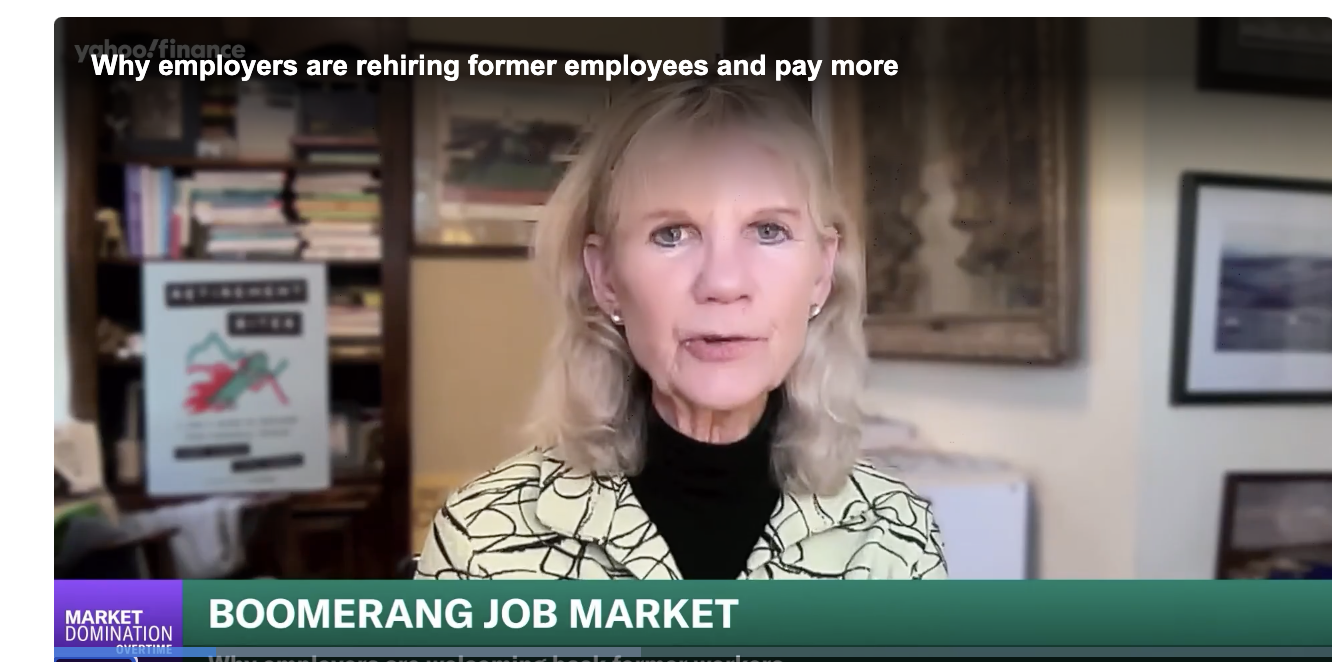
Now Bentley is one of many workers heading back from what they thought were greener pastures. Returning to work for a former employer, known as boomeranging, is gaining traction.
Last month, the news that Ford Motor Co. has been bringing back many former employees in engineering quality control put a spotlight on the trend.
“Employers are increasingly recognizing that rehiring former employees isn’t looking backward — it’s a smart way to move forward,” Robin Erickson, head of human capital research at The Conference Board, told Yahoo Finance.
“In an environment where hiring remains expensive and finding the right talent is challenging, boomerang employees offer something that’s hard to replicate: proven performance, institutional knowledge, and a much shorter path to productivity.”
They’re also returning with new skills and outside perspectives, while already understanding the organization’s culture and how to get work done, she added.
‘Careers are much more dynamic’
There has been a mindset shift among employers. A voluntary departure is no longer automatically viewed as the end of the relationship.
“Organizations are realizing that careers are more fluid, and employees often leave to gain new experiences,” Erickson said, “When those high-performing employees return, companies benefit from lower hiring risk, faster onboarding, and talent that’s often even more valuable than when they left.”
And that’s a big help in today’s hiring landscape.
Nearly 70% of human resource professionals say that recruiting for full-time positions is challenging, according to the Society for Human Resource Management (SHRM). And half say recruiting is more difficult than it was a year ago.
The skills they are seeking: communication, judgment, decision making, complex problem-solving, and time management. It’s also a struggle to find applicants with “power skills,” which include creativity and critical thinking.
“Today’s careers are much more dynamic than they were a generation ago,” Jim Link, SHRM’s chief human resource officer, told Yahoo Finance. “It’s increasingly common for employees to leave an organization, gain new skills and experiences, and later return in a role that’s an even better fit.”
Recruiters and companies are inundated with resumes, many of which have been enhanced by AI and all read the same.
The result: More recruiters and companies are “leaning on more traditional methods for finding candidates, like going back to career fairs or sourcing or relying on their networks,” said Daniel Zhao, chief economist at Glassdoor.
“And in this case, boomerangs are a great source of talent that companies can rely on.”
Hiring remains pretty low overall, and that means job seekers have fewer opportunities, said Cory Stahle, Indeed’s senior economist.
“As a job seeker, sometimes the easiest path is to get back in with an employer that you’ve been with in the past.”
For employers, the costs of onboarding and training are top of mind as they try to hold down labor costs. “In a world where employers are focused on immediate returns on investment, they are eager to hire talent who don’t need lengthy training,” added LinkedIn’s Andrew Seaman.
Advice for job seekers
You can look back.
If you parted with a job on good terms, don’t be shy. Check back in.
“Being open to opportunities at a former employer and having strong connections there can mean less time unemployed or at another job that isn’t fulfilling,” Seaman said.
Have an honest conversation.
You want to say: “I left. I learned new things. I realized there’s more I want to give the organization,” Bentley said.
Do some sleuthing.
Check out former employer alumni groups on LinkedIn and Facebook, as well as job boards, to see if there’s a position that catches your eye.
Spotlight your new skills.
When you reach out, have your new talents ready to showcase as well as your enthusiasm for how these will benefit the employer. It’s always about what you can do for the company, not what they can do for you.
Be honest with yourself about why you resigned.
“Ask yourself if you really enjoyed your time at the company,” Zhao said. “If so, chances are you will probably be satisfied again when you join. What we see in our data is that … whatever your experience was the first time is going to be pretty similar to what your experience is the second time.”
Kerry Hannon is a Senior Columnist at Yahoo Finance. She is a career and retirement strategist and the author of 14 books, including “Retirement Bites: A Gen X Guide to Securing Your Financial Future,” “In Control at 50+: How to Succeed in the New World of Work,” and “Never Too Old to Get Rich.” Follow her on Bluesky and X. You can reach her at kerry.hannon@yahooinc.com
